Scale or Fail:
Why Africa Must Embrace Shared Ownership ?
In the global competition for capital, size matters.
The breakdown of multilateralism and aid flows, alongside rising conflict in the Middle East, is redrawing capital allocation and sharpening investors’ search for stability and scale. Scale has also become a defining corporate imperative, as leading nations in Asia and North America are leveraging advanced technological expertise – from clean energy and digital platforms to manufacturing and finance – to project influence through their major companies. As for Europe, having created the world’s most integrated common market, it is now seeking to better harness this strength to foster more truly continental champions like Airbus, recognising the cost of overlooking this fundamental shift:
Scale is no longer an option. It is the first line of defence.
In this new world, can Africa rise to the occasion? The continent has demonstrated resilience, with growth rates rising, sovereign ratings improving, and the AfDB securing record replenishment. But as the European experience has shown, if Africa is to compete on the global landscape, reaching the necessary scale will require not only removing the physical and regulatory barriers but also encouraging the emergence of truly continental champions and projects. Achieving this will mean moving beyond a mindset sometimes anchored in economic patriotism and embracing a new vision: shared ownership.
Shared ownership offers Africa its clearest path to scale.
Shared ownership requires African nations and businesses to invest not only in themselves but also in one another’s success through 3 core pillars:
- Shared equity. Can a Moroccan banking giant co-invest with South African and Kenyan shareholders to facilitate its continental expansion strategy? How can African pension funds gain exposure to domestic infrastructure projects, following the model of Nigeria’s InfraCo? Can African stock exchanges better incentivise the listing of multinational subsidiaries, so domestic retail and institutional investors can benefit from their upside?
- Shared infrastructure. What will it take to launch transformative cross-border mega-projects like the Lobito Corridor across other strategic industries? How can Africa create megaprojects that meet regional not merely national needs, like the Dangote Refinery? How to push Africa’s natural resource giants seek out infrastructure and industrial complementarity?
- Shared frameworks. Can the successes of the CIMA insurance and OHADA legal frameworks be replicated in other regions? Can African businesses and governments collaborate to build future-proof digital rails for health, education or agriculture? How can PAPSS impose itself as the standard for African cross-border payments?
Back in Kigali on 14 and 15 May, the Africa CEO Forum calls on its community of business leaders, investors, heads of state and ministers to embrace a shared vision: forge alliances across borders, share risk and capital, and commit to building continental champions — enabling Africa to secure resilient growth, create jobs and claim its place in the new global order.
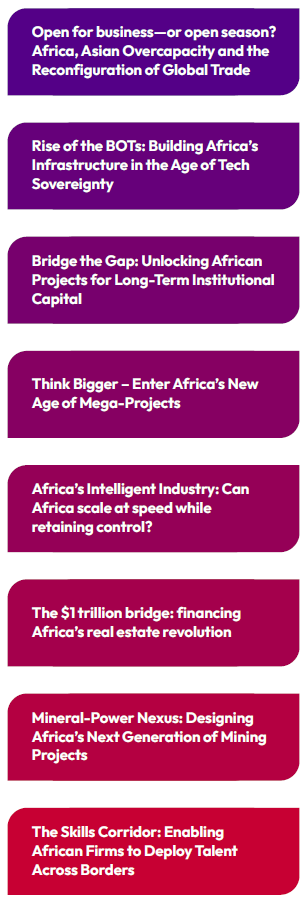
In Kigali, the Africa CEO Forum’s community of 2,500 decision-makers will engage in executive dialogues, open debates and negotiations to address how shared ownership can be advanced to achieve scale. Key topics to be explored include: